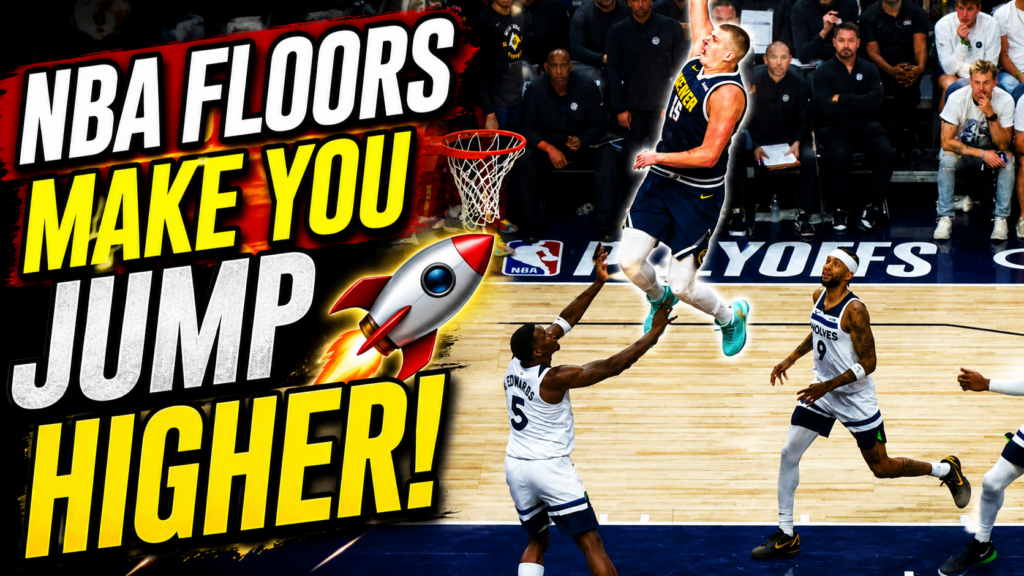
If you’ve ever dunked on a hardwood court and felt like something was different, like the floor was working with you instead of against you, you weren’t imagining it. NBA courts are specifically engineered to make you jump higher, absorb the impact of your landings, and protect your joints in ways that concrete, asphalt, and even regular gym floors simply cannot.
This is the science behind why the surface you dunk on matters more than most people realize.
@dunkademics NBA floors are engineered to make you jump higher! #dunkademics #nba #basketball
What NBA Courts Are Made Of
Every NBA court is made from hard maple. Specifically, it’s Acer saccharum, northern hard maple sourced primarily from the Great Lakes region of North America. This is one of the densest, tightest-grained woods on the planet, and 29 out of 30 NBA courts use it as their playing surface.
But the wood on top is only part of the story. What’s underneath is where the real engineering happens.
Under the maple surface sits a full engineered subfloor system. According to U.S. patent specifications for NBA-grade court systems, the construction goes like this, from top to bottom:
- Hard maple surface layer — the playing surface itself, tongue-and-groove fitted strips
- Two layers of cross-oriented plywood subflooring — laid at 90-degree angles to each other for structural strength
- Rubber and foam shock absorbers — spaced at precise intervals (typically every 9-and-13/16 inches) between the subfloor and the concrete slab below
- Concrete slab base — the rigid foundation the whole system floats above
The key word there is “floats.” The entire playing surface is not sitting directly on concrete. It’s suspended above it by a system of engineered shock absorbers. That gap is what makes everything different.
The Science: Why This Makes You Jump Higher
When you load up to jump, you push down into the floor. On concrete or asphalt, that force has nowhere to go. The surface is completely rigid, so 100% of that load transfers back into your joints. On an NBA floor, the floor actually compresses slightly under your weight, then pushes back.
That return energy goes back up through your legs and adds to your jump. It’s a small but measurable trampoline effect built directly into the floor surface. You are literally getting free inches on your vertical from the engineering of the court you’re playing on.
The maple itself contributes to this. Because of its grain density and natural flex properties, hard maple stores and returns elastic energy more efficiently than synthetic surfaces. When you plant and push off, the floor participates in your jump in a way that concrete fundamentally cannot.
The Impact Absorption Numbers Are Staggering
The Maple Flooring Manufacturers Association (MFMA) certifies NBA-grade floors using their Performance and Uniformity Rating (PUR) standards. One of the key metrics is force reduction: the percentage of landing impact the floor absorbs before it reaches the athlete.
According to MFMA standards, a certified sports floor with a force reduction value of 60% will absorb 60% of impact force, with the athlete absorbing only the remaining 40%. Concrete and asphalt, by contrast, provide little to no force reduction, meaning your body absorbs nearly 100% of every landing.
Think about what that means for dunkers specifically. Every time you land from a dunk attempt on asphalt, your knees, ankles, and hips are absorbing the full force of your body weight plus the downward momentum of the jump. Do that hundreds of times a week and the cumulative damage adds up fast.
On an NBA floor, the engineered subfloor system absorbs up to 60% of that same force before it ever reaches your joints. That’s not just performance. That’s injury prevention built into the floor itself.
NBA Floor vs. Regular Gym Floor vs. Asphalt: The Real Difference
Not all hardwood floors are equal. A basic gym floor with no engineered subfloor system sits directly on concrete, which means you get the grip and surface feel of wood without the shock absorption benefits. The difference is entirely in what’s underneath.
Here’s a practical breakdown of what you’re dealing with on different surfaces:
- Asphalt / Concrete — 0% force reduction. Every landing is absorbed entirely by your body. Zero energy return on takeoff. Highest injury risk over time.
- Basic gym floor (wood on concrete) — Minimal force reduction. Some surface grip benefits but no engineered absorption system underneath.
- Certified hardwood sports floor — 35-60% force reduction depending on system. Measurable energy return on takeoff. Significantly lower impact on joints.
- NBA-grade engineered floor — Maximum force reduction and energy return. The top tier of what sports floor engineering currently offers.
If you’ve ever noticed that your legs feel fresher after playing on a proper hardwood court versus outdoor concrete, that’s not a mental thing. That’s physics. Your body is literally doing less work absorbing impact when the floor is doing it for you.
Why This Matters for Dunkers
For freestyle dunkers specifically, this is one of the most underappreciated factors in performance and longevity. For the dunkers who train on concrete their whole career and wonder why their knees are breaking down, the surface is a major part of that equation.
The best dunkers in the world, the athletes competing in DUNKMAN on TNT and the ones Dunkademics has been filming for over a decade, train on proper hardwood as much as possible. It’s not just about jumping higher in the moment. It’s about preserving the joints and tendons that make high-level dunking possible for years.
Next time you get access to a legitimate hardwood court, pay attention. Notice how the floor feels when you load up. Notice how your landing feels softer. Notice if your legs feel less beat up after an hour of sessions compared to outdoor concrete.
That’s not your imagination. That’s engineering. And the best dunkers in the world have it working for them on every single jump.