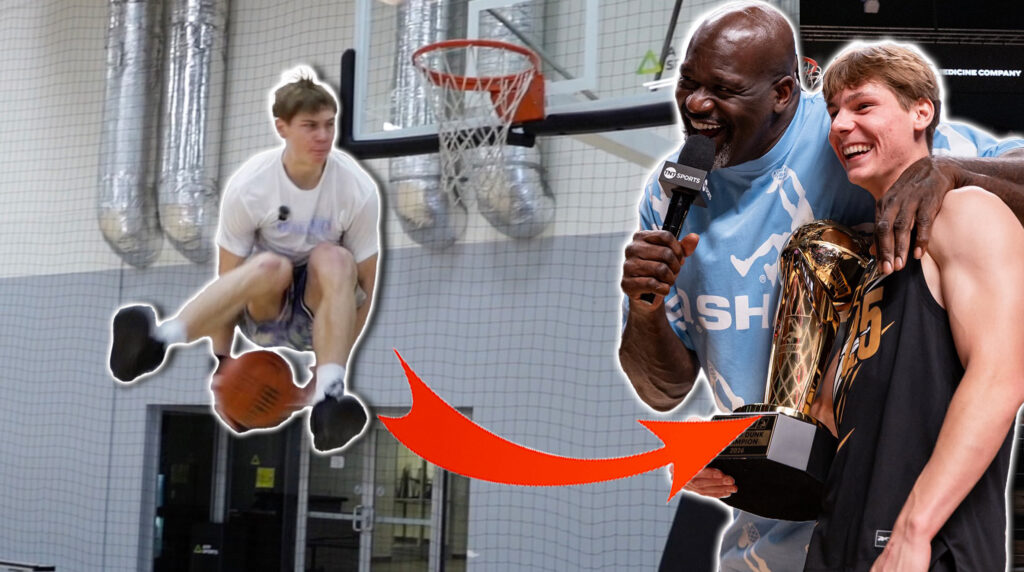
I’ve been filming the world’s best dunkers since 2011. I’ve seen elite athleticism up close more times than I can count. But coaching Cam Hazzard to the DUNKMAN World Championship — and watching him walk out of Atlanta with $500,000 — is something I’ll carry for the rest of my life.
This is the story of how we built a championship dunk plan from the ground up.
How It Started
Cam and I had been talking for months before the competition. Not just about dunks — about strategy. DUNKMAN wasn’t just a dunk contest. It had a scoring system with pro dunkers as judges, bonus elements, and multiple rounds. That changes everything about how you approach it.
From the beginning, we both knew that winning wouldn’t come down to just throwing your best dunk and hoping for the best. It would come down to preparation, sequencing, and having the right dunk for the right moment.
Building the Plan: Six Dunks, Multiple Contingencies
We mapped out six high-level dunks that Cam would have ready for the competition. Each one was selected for a specific reason — degree of difficulty, originality, crowd reaction, and most importantly, scoring potential with the judges.
But we didn’t stop there. For every primary dunk, we built contingencies. Replacement dunks. What happens if he misses? What’s the backup that still scores well but preserves energy for the next round? We built out a list of every possible dunk that Cam might use for the contest
Most dunkers walk into a contest with three dunks and a prayer. Cam walked in with a complete playbook.
The Scoring Game
This is where our conversations got deep. DUNKMAN’s scoring system rewarded dunks that had added “elements” — details that pushed a dunk beyond the base move and into bonus territory with the judges. We spent a lot of time breaking down exactly what those elements were and which of Cam’s dunks naturally had them built in.
A 360 is one thing. A 360 under both legs is another category entirely. We identified which of Cam’s dunks would score in the high 9s on their own — and which needed a small creative addition to cross into elite territory. Then we drilled both versions until Cam could execute either one in competition conditions without thinking about it.
The Last Session
The final workout before the championship was a 3.5 hour session — one of the most focused training sessions I’ve ever been part of. We ran through everything. Every dunk in the playbook. Every contingency. Every call and every decision tree. By the end of it, Cam didn’t need me in his ear. He had the whole game plan internalized.
He got on a plane straight from that session to appear on The Pat McAfee Show on ESPN — and then headed directly to Atlanta for the championship.
The Pat McAfee Shoutout
What meant a lot to me wasn’t just watching Cam win — it was hearing him talk about the process publicly. On his appearance on The Pat McAfee Show on ESPN, Cam thanked me directly, calling me out as his dunk coach and crediting the preparation we’d done together as part of what got him ready for the biggest night of his career.
That’s what Dunkademics is about. Not just filming dunks — but being part of the journey that gets a dunker to the top.
What Cam Proved
Cam Hazzard is 21 years old, triple-majoring at Abilene Christian University, training about six hours a week in the weight room. He beat 23 of the best dunkers in the world on the biggest stage the sport has ever had.
He did it because he’s extraordinarily talented. He also did it because he came in with a plan — and he trusted the process we built together.
The $500,000 is Cam’s. The championship is Cam’s. But I’m proud of every conversation, every session, and every contingency dunk we ever talked through that helped get him there.