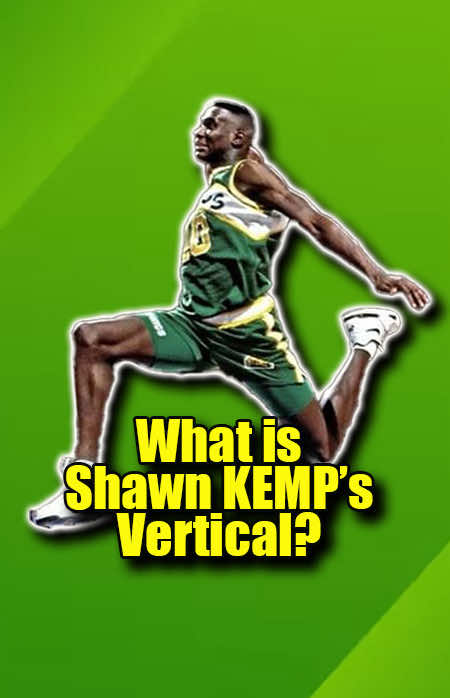
Shawn Kemp could make a dunk feel like a collision. The Lister play, the posters over Dikembe Mutombo, the celebrations: none of that needs a 40-inch vertical to be great. After looking through contest lobs, game dunks and the clearest stills I could find, I put his highest jump at about 36 to 37 inches.
Why the dunks look so high
Kemp was about six-foot-ten in the height I use here. A ten-foot rim is 120 inches high, so the top of his head would need to rise roughly 38 inches just to reach it. In the best footage I found, including full-approach contest lobs and the Antoine Carr and Lister dunks, I cannot see a clean frame with his head level with the rim. At 40 inches it should be roughly two inches above; at 42, roughly four. That is why those popular numbers do not fit the clips I am using.
Think about what the camera follows in a Kemp highlight: the defender, the contact, and the force of the finish. His hand needs to get over the rim, but his head does not. With Kemp’s height and reach, a huge dunk and a head position below the rim can both be true. The top of his head is the reference I use here, rather than how hard the ball goes through the hoop.
Where I land
If his highest-looking attempts leave his head a little short of the rim, 36 to 37 inches is a better fit than 40 to 42. This is a footage estimate, so a genuinely clearer jump could change it. Blake Griffin is a useful comparison: at roughly the same on-court height, his best Clippers lobs appear to take his head to or above rim level. That is why I have Blake near 40 and Kemp a few inches lower. The NBA vertical table puts both alongside the source videos.
Kemp also said he could touch the top of the backboard. I have not found a documented attempt that establishes that claim, and it is a different question from the height visible in these dunks. If you have a clear angle of a higher Kemp jump, send the actual clip. The number should move with the evidence, not with how memorable the poster was.